
Where The Air Gets Thin: A Conversation with Dr. Tracee Metcalfe
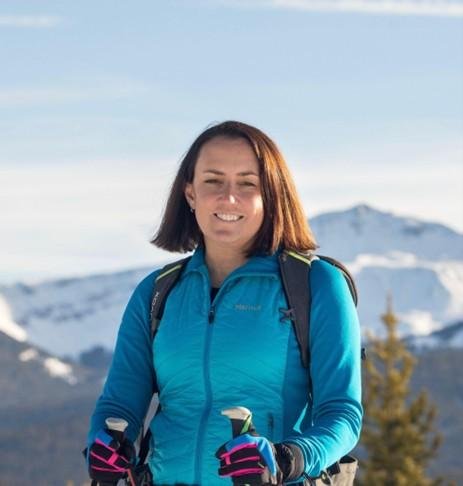
Grady Vought
Volume 43, Issue 1
Column: Society News
WMS Conference Ambassador Grady Vought interviews Dr. Tracee Metcalfe about memorable summits, limitations, and the realities of high altitude climbing. Dr. Metcalfe is a featured speaker at the 2026 Winter Conference on Expedition Medicine at Altitude.
WMS Conference Ambassador Grady Vought interviews Dr. Tracee Metcalfe about memorable summits, limitations, and the realities of high altitude climbing. Dr. Metcalfe is a featured speaker at the 2026 Winter Conference on Expedition Medicine at Altitude.
Dr. Tracee Metcalfe is an internal medicine physician and has gained international recognition as the first US woman and 3rd US person to climb to the summit of the 14 tallest mountains in the world. Dr. Metcalfe climbed multiple of these peaks while serving as an expedition doctor, including Denali, Everest, Manaslu, Makalu and Cho Oyu. Her international experiences have inspired her to become an ambassador for dZi, a community led charity serving the people of rural eastern Nepal, and is involved with Ascend: Leadership Through Athletics, an organization working to empower young women in Afghanistan and Pakistan. Dr. Metcalfe also recently opened her own internal medicine practice called The Synergy Clinic.
Grady Vought (GV): You once said that choosing your favorite climb is based more on the team you were with than on the mountain itself. What makes a good team, and what about a good team makes for a more memorable climb?
Dr. Tracee Metcalfe (TM): For me, a good team comes down to shared values, compatible risk tolerance, and mutual respect. When you genuinely enjoy spending time with people and trust their judgment, everything else flows more smoothly. The mountains amplify whatever dynamics exist in a team – if there’s ego, poor communication, or mismatched expectations at sea level, those issues become magnified at altitude. But when you’re with people you respect and enjoy, even the hardest days become some of your most memorable experiences.
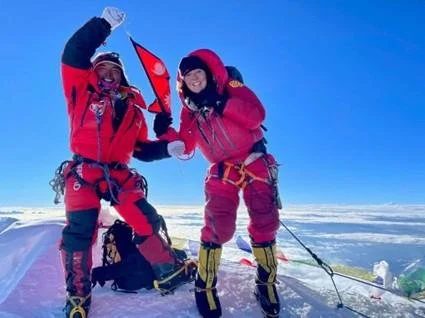
Dr. Metcalfe and Tamting Sherpa at the summit of Kanchenjunga, the 3rd highest peak in the world.
GV: You summit all these mountains while wearing contacts, with a hip replacement, an arthritic knee (now replaced knee), and with a fear of heights. What advice do you have for others hoping to get involved in the outdoors who face similar barriers?
TM: For me, it was important to view these limitations as problems to solve rather than reasons not to try. For physical barriers, there are always ways to adapt. I’ve watched people summit Everest with arm and leg amputations, so having arthritis felt like something I could work around.
For mental barriers like fear of heights, I found progressive exposure in natural environments helped me recognize and manage the physical symptoms – increased heart rate, racing thoughts, and feelings of panic. I learned breathing techniques to moderate these responses as I gradually pushed my comfort zone in the mountains.
I also worked with a therapist using EMDR to specifically address the panic associated with my fear of heights. This clinical approach complemented the exposure work I was doing on my own and gave me additional tools to process the anxiety.
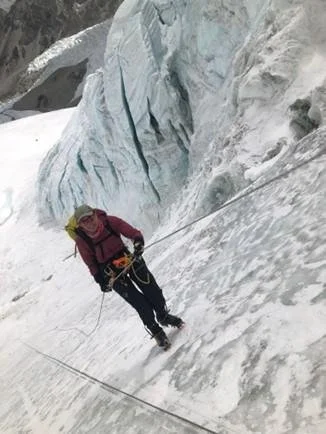
Dr. Metcalfe repelling down Makalu on the Nepal-China boarder
GV: Your work with Ascend interests me because gender discrimination in the outdoors was the topic of my undergraduate thesis. What are your thoughts on how to make the outdoors more inclusive, and how do you see the outdoor community accomplishing this?
TM: The outdoor industry has historically excluded people – through economic barriers, through lack of representation, and by making people feel unwelcome. Changing that requires intentional action, not just good intentions.
In Pakistan and Afghanistan, Ascend does this by creating safe environments for women to learn mountaineering. I’ve seen similar approaches work in the US – organizations that provide free gear access, build community for underrepresented groups, and actively develop outdoor leaders from those communities. The common thread is being deliberate about removing specific barriers.
My suggestion would be for people to find out what organizations in their local communities are working actively to make the outdoors more inclusive and get involved. For example, here in the Vail Valley there is a program called The Cycle Effect that teaches girls mountain biking by providing bikes and equipment and pairing them with experienced coaches.
Given your undergraduate thesis, I’m curious how you think the outdoor community can improve this?
GV: My research, while small, showed how severely negative gender-based discriminating comments during outdoor recreation can alter someone’s relationship with that sport. However, a bystander speaking up can make a harmful event into one where community care is actively demonstrated. I think the first step is creating a culture that actively speaks up for each other.
GV: As an expedition doctor and a dZi ambassador, you have had an inside look at the mountaineering industry. According to The Himalaya by the Numbers the death rate of sherpas has fallen 1.82 to 0.64 in more recent years but remains troublingly high. As someone dedicated to helping the people of Nepal after centuries of Imperialism and later neo-colonial influence, what do you see as the mountaineer’s role in continuing positive change in this industry?
TM: The declining death rate is encouraging but you’re right that it remains too high. As mountaineers, I think we have several responsibilities:
First, we need to acknowledge that Sherpa deaths often result from taking risks that serve our summits. The Khumbu Icefall is a perfect example – Sherpas make dozens of carries through the most dangerous section while clients might pass through just a few times.
Second, we can support organizations like dZi that provide healthcare, education, and economic development so that climbing isn’t the only viable economic option for Nepali families. I became a dZi ambassador because I believe healthcare is a fundamental right, not something you should have to risk your life in the death zone to access.
Finally, as clients, we need to examine our own decision-making. Are we creating pressure for teams to take unnecessary risks? Are we paying fair wages? Are we respecting turn-around times? The deaths have decreased partly due to better safety equipment and protocols, but also because of cultural shifts in how expeditions operate. We need to continue that evolution.
GV: You wrote a blog post about the spirit of Misogi, the Japanese concept of pursuing goals you might not succeed in, and how it relates to your recent mountain bike crash and taking a step back from biking. Since then, how have you been embracing the spirit of Misogi in your life?
TM: Currently I’m embracing Misogi through public speaking, which gives me tremendous anxiety and which I’ve avoided most of my adult life, and through writing a book about my climbs. I have no writing experience, so once again I’m back to being a beginner – which is exactly where the growth happens.
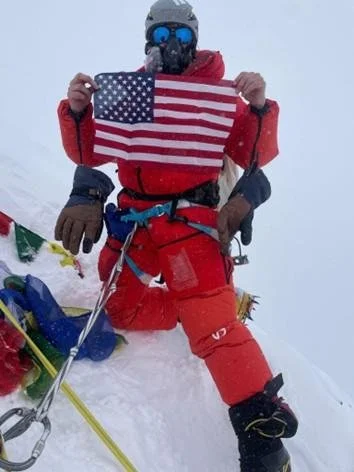
Dr. Metcalfe at the summit of Lhotse, which means “South Peak” in Tibetan, referencing its location next to Everest
GV: As a medical student who loves the outdoors, I have hoped to pursue wilderness medicine through emergency medicine. However, you did it through Internal medicine and a diploma in mountain medicine. What got you on this path, and would you recommend it to other aspiring physicians hoping to practice in the outdoors?
TM: I think emergency medicine is the most direct path to wilderness medicine, but family medicine, internal medicine, and other specialties can absolutely work. As an internist, I worked with local SAR teams and spent time in the ER at my hospital to learn how to manage fractures, dislocations, etc.
The DiMM teaches high-altitude medicine, expedition planning, and austere environment care that my internal medicine training didn’t cover. What matters most is having a solid foundation in physiology and the curiosity to keep learning. You can always supplement specific wilderness skills through courses, but the clinical reasoning and medical foundation from any specialty will serve you well.
